


Every month we write a piece encompassing themes within our whole-person health thesis. If you would like to receive it directly in your inbox, subscribe now.
Note: Findings throughout draw on a proprietary survey of 606 weekly exercisers in the U.S., commissioned by Next Ventures. Methodology in the appendix.
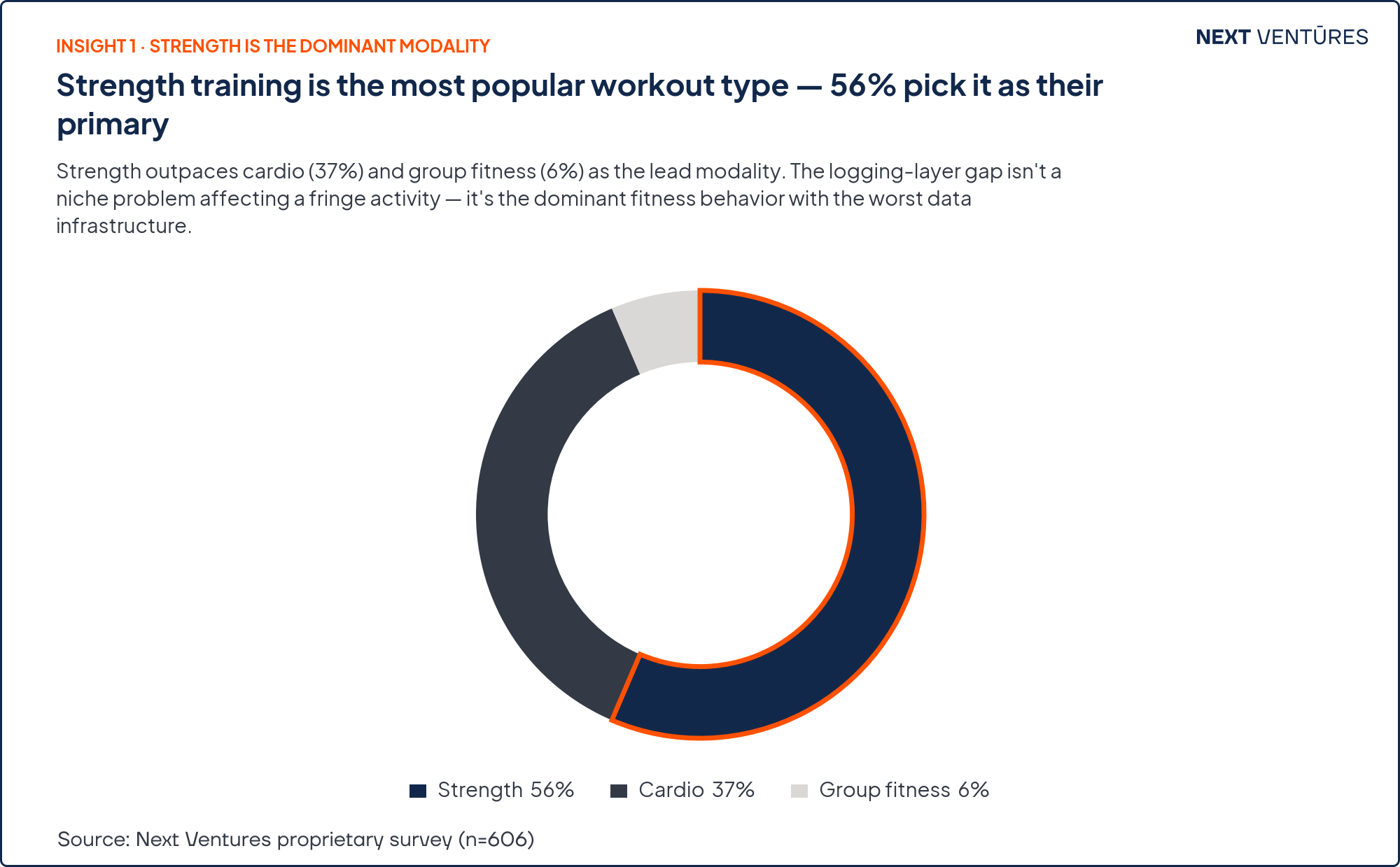
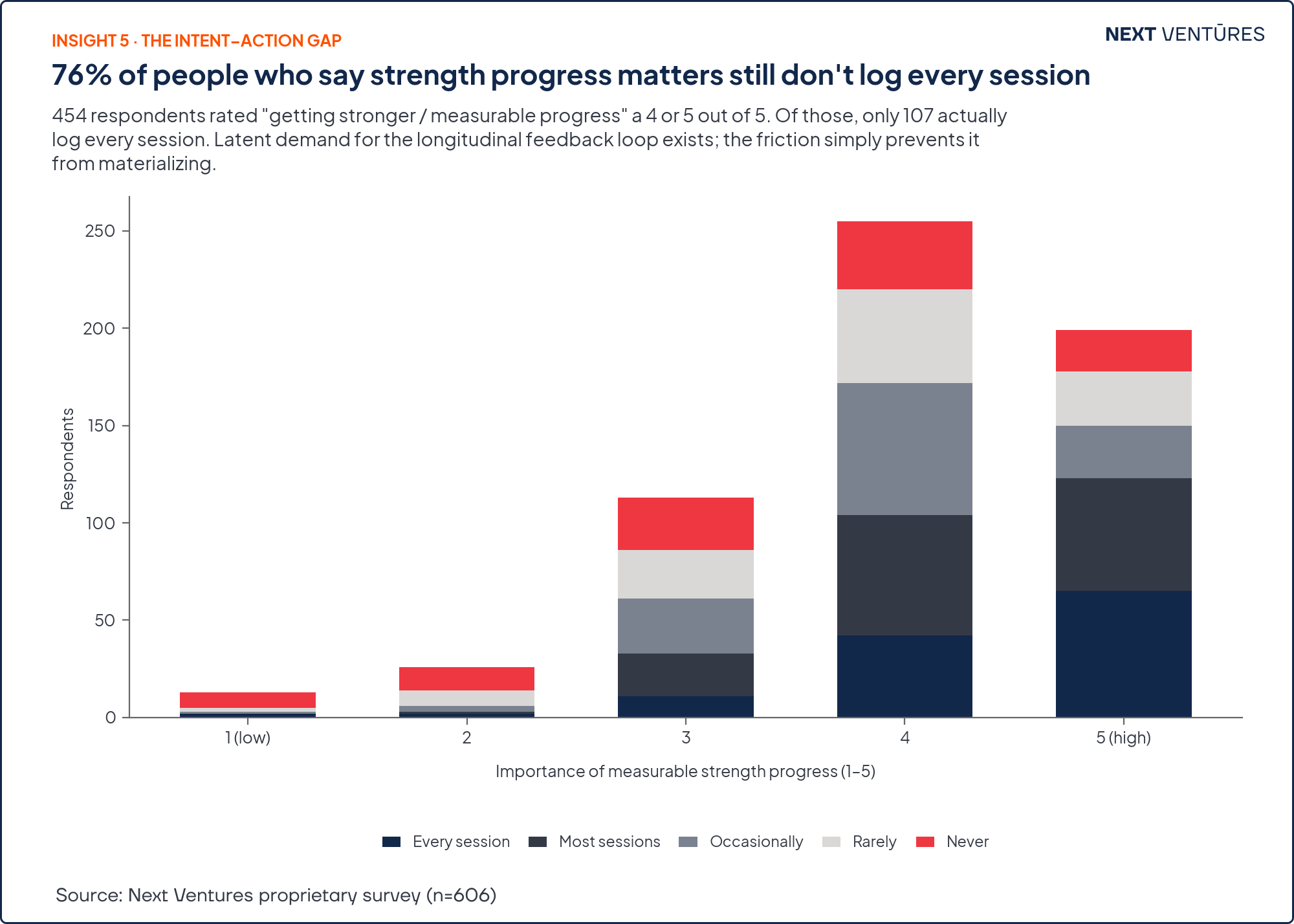
Despite strength training being the single most popular workout type, it remains the last bastion of fitness without a real data layer enabled by frictionless capture. It’s hard to fathom a world in which I run without my Garmin or ride without my Hammerhead. Anyone who has left their device behind on a trip, or made it out the door on a cold morning only to realize it’s still sitting on the counter, knows the particular dread that follows. Understanding pace, heart rate, power, etc. and how they trend longitudinally is table stakes not only for engaging in these activities, but also for improving at them over time. So it baffles me why most people make concessions on this when it comes to strength training, where only 1 in 5 log their exercises, sets, reps, and weight every session. However, digging one layer deeper reveals that it's not a personal choice. The fitness app category has spent a decade optimizing around the logging problem rather than through it, building engagement loops on streaks, social, and content because the foundational input layer was too hard to crack. The result is a structural gap where the most popular form of exercise has the weakest data layer.
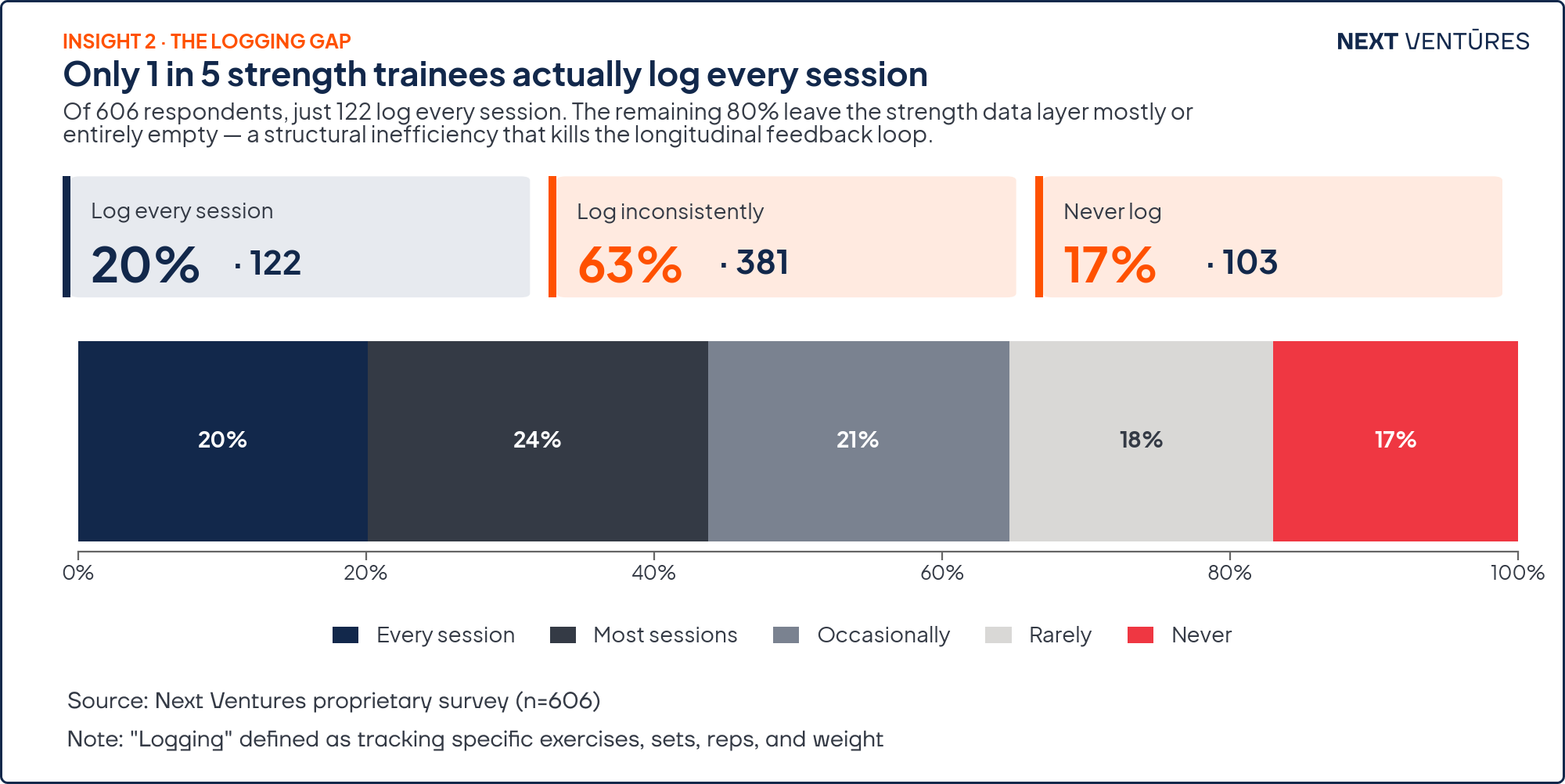
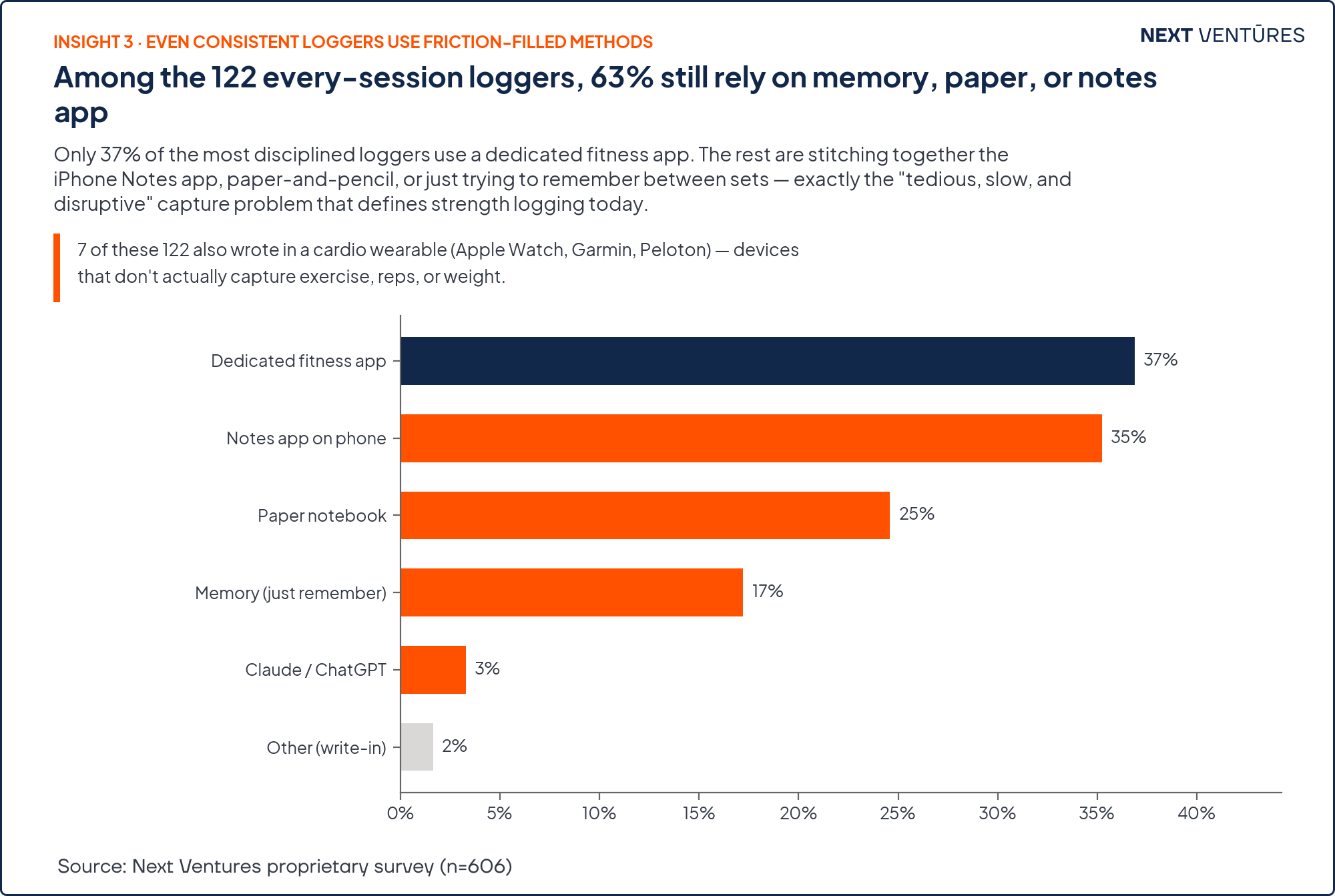
One of the most underrated features in any strength training experience is logging, which is the only reliable way to execute progressive overload over time. How else do you understand whether you’re getting stronger, progressing on a program, or hitting a plateau? And yet, the act of logging itself is incredibly friction-filled. While hardcore purists still log reps and weight with a paper “journal” and pencil, the reason strength logging hasn’t permeated the mass market is pretty simple. Punching numbers into a phone screen between sets is tedious, slow, and disruptive to the flow of a workout. Data transfer via digits (our hands) is incredibly inefficient relative to voice or neural interfaces. In fitness, progress is directly correlated with consistency, and friction kills consistency. And without consistent data capture, the longitudinal feedback loop that makes endurance sports so sticky never materializes for strength.
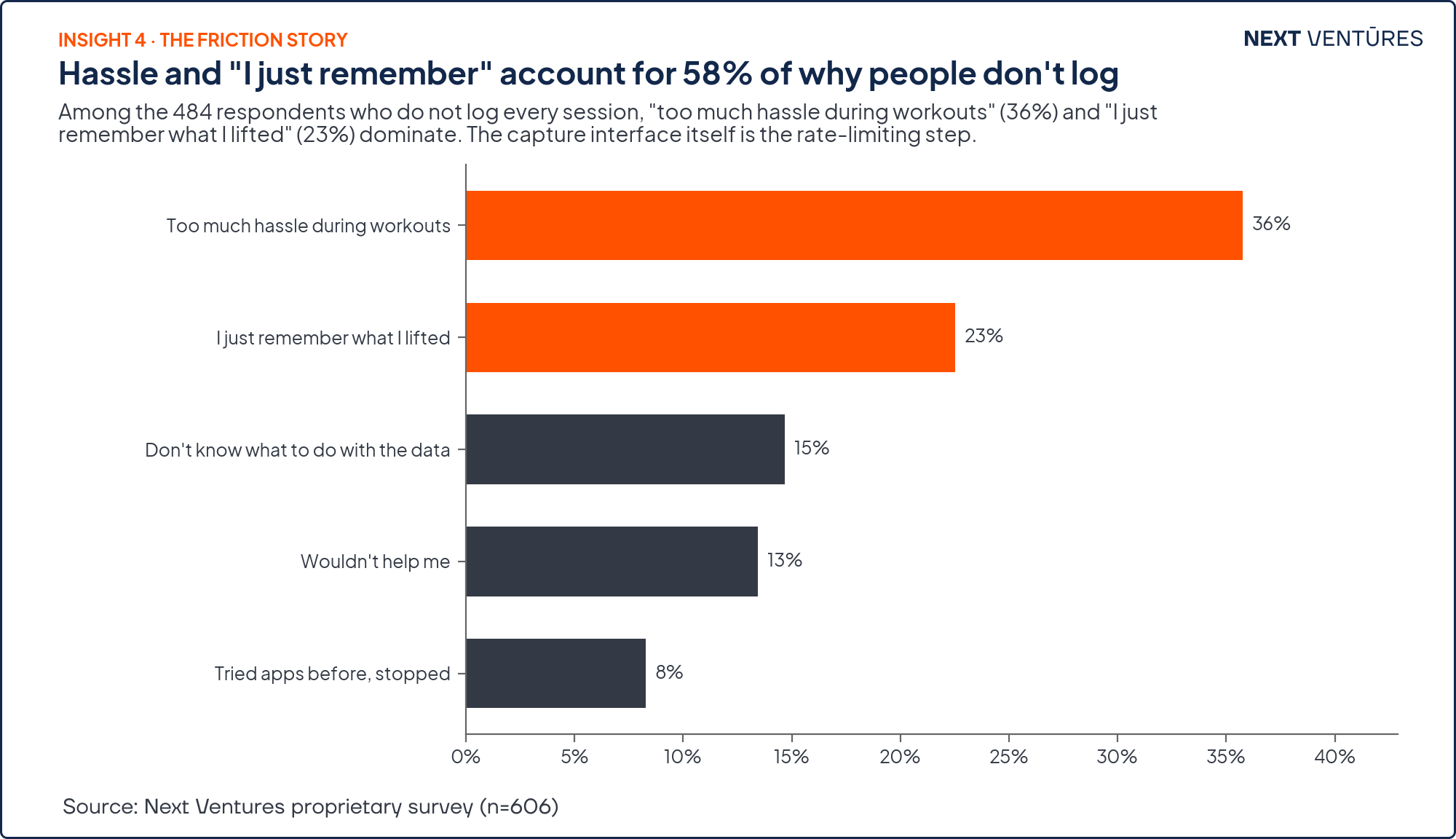
Ladder is probably the best example of why this problem is so hard. They've built something genuinely compelling. A one-to-many model that groups users into identity-driven protocols, making the experience feel personalized without the cost structure of true 1:1 coaching. You're not following a generic program like you would on Peloton or Apple Fitness. You're following a protocol built around who you are and what you're training for, and the community dynamics around those protocols create a sense of belonging that actually drives retention. The UI is delightful and engagement is best-in-class. And yet, even Ladder hasn't solved what I'd argue is the foundational problem sitting upstream of everything they're optimizing for. Their "Track Results" feature exists, but it feels secondary. It's more of a manual, write-only database than a system that frictionlessly ingests data and feeds it back into contextual programming. The logging layer still leaves a lot to be desired, and if capturing what you're doing in the gym still carries friction, the entire data flywheel that culminates in progress never spins up.
We’ve spent a lot of time on the strength logging problem, and we’re seeing innovation emerge along three distinct approaches.
🗣 Dictation and voice-first logging
Dictation has exploded across knowledge work through tools like Wispr Flow and Willow, rapidly becoming the primary computing interface and making the experience of using a computer feel magical. That same shift is now showing up on the gym floor. We’re seeing companies like Spotr building voice-first logging for strength training, and the UX unlock is meaningful. Instead of tapping into a reps field, entering a number, tapping into a weight field, entering another number, and then checking a box to confirm completion, all between sets, you just say it. The friction disappears, and suddenly building a longitudinal dataset becomes seamless. Over time, that dataset enables personalized programming, progress tracking, and the feedback loop that strength training has been missing.
🏋️♂️ Wearables (“Whoop for strength”)
A handful of emerging companies are building wearables packed with accelerometers, gyroscopes, and heart rate sensors that use sensor fusion to automatically detect exercises, count reps and sets, score session intensity, and attribute muscle groups without any manual logging. Fort is leading the pack in the dedicated hardware path, building a purpose-built wristband that covers 50+ priority gym exercises and uses velocity-based metrics to flag fatigue and proximity to failure. Motra is attacking the same problem from the software side, layering automatic detection across 470+ exercises onto the Apple Watch's onboard accelerometer rather than building its own device. This is a nascent space, but the innovation cycles are moving fast. Teams are iterating on both form factor and detection models to figure out how to ubiquitously capture all movements done on the gym floor. As exercise coverage expands and the models learn to approximate weight, the path to a mass-market passive workout tracker will get clearer with each generation. We're watching this closely because the core UX promise, a wearable that captures your entire strength session without you touching your phone, is exactly the kind of zero-friction experience that drives real consumer adoption.
🖲 Computer vision + sensors (“EGYM 2.0”)
The incumbents here have broadly split into two camps. Technogym operates like Apple, building a premium, tightly integrated ecosystem where facilities have to commit heavily to proprietary hardware to unlock the full digital experience. EGYM takes more of an Android approach with open APIs and interoperability across select third-party equipment in addition to their own proprietary machines. EGYM has built a massive business and recently merged with Playlist, the parent of Mindbody, ClassPass, and Booker, at a combined $7.5 billion valuation.1 But both share the same structural limitation. Their sensors and machines only cover a ring-fenced set of exercises, operators consistently push back on pricing, and the member experience leaves a lot to be desired.
“We only went with five pieces of [EGYM] equipment which reflect the major muscle groups, so leg press, chest press, hip thrust, lat pull down, and the rotary torso. We’re doing glutes, abdomen, legs, back, and chest…Of course, it’s extremely expensive. That’s why we just did the five major muscle groups.”
-CEO, Major big-box gym operator
Now we’re seeing a new wave of companies move past the incumbent playbook entirely. Where Perch pioneered camera-based tracking for elite performance before Catapult acquired them,2 this next generation is targeting big box and premium operators by combining machine-agnostic sensors with bird’s-eye-view computer vision to track a member’s entire workout across the gym floor, automatically and ambiently. Reps, weight, time under tension, velocity-based training, all captured without the member doing anything, tapping into the “no consumer behavior change required” approach that we love.
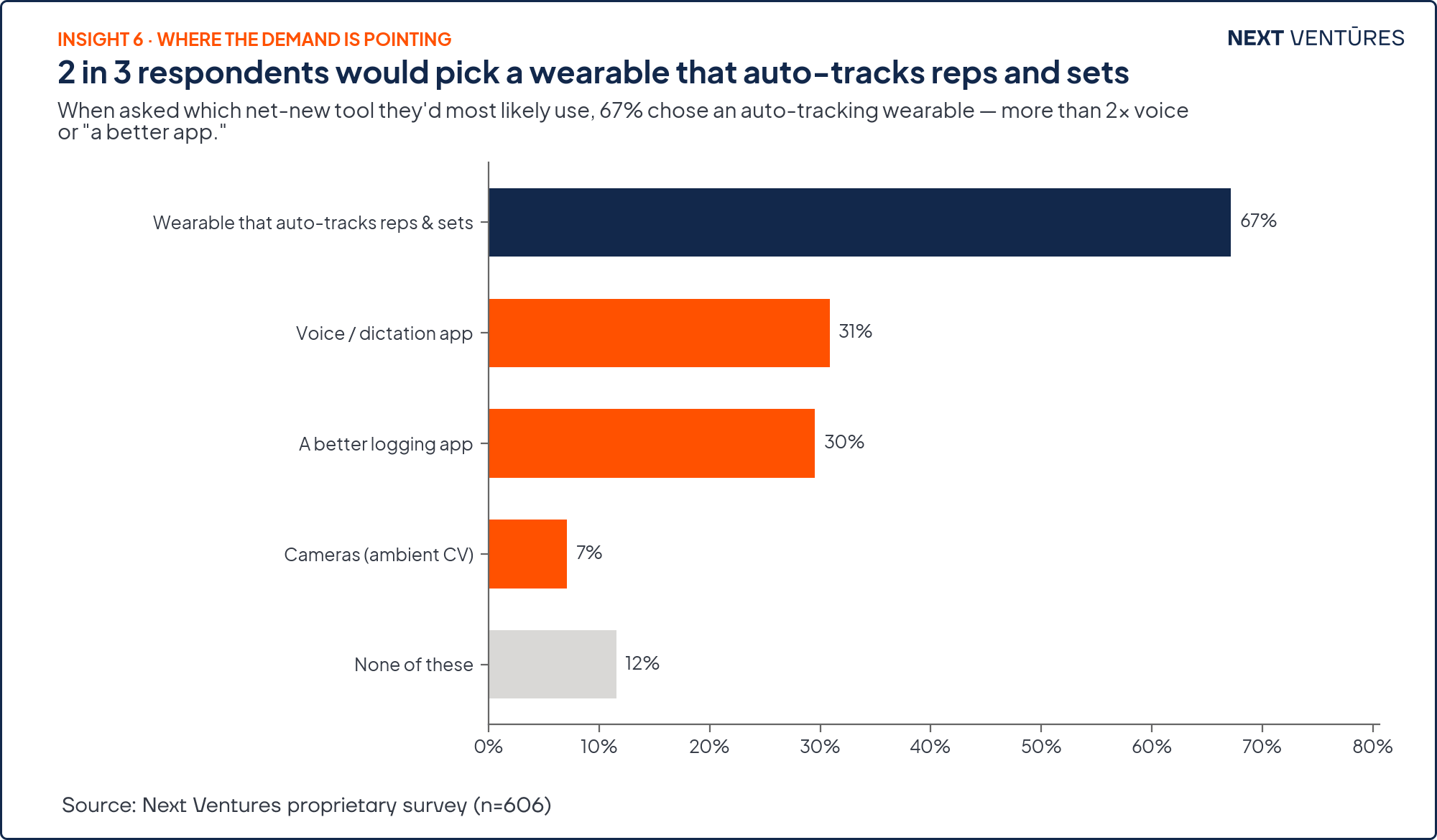
The question worth sitting with is whether gym-goers will actually value a longitudinal memory layer for their workouts enough to accept the privacy tradeoff that ambient monitoring requires. Knowledge workers are more than willing to let Granola record their conversations because a longitudinal layer that captures and indexes their work delivers ROI that meaningfully outweighs the privacy cost. The data today suggests gym-goers haven’t cleared that bar yet, and privacy is probably part of the story. But latent demand is hard to read before the product exists to reveal it, and that’s the cold start problem every new behavioral category faces. Someone has to build it and put it in front of people before the demand becomes legible.
There's obviously friction involved in getting operators to pilot something this disruptive. One leading operator we spoke with flagged that physical installation alone would be disruptive to active members and suggested piloting at a smaller, off-brand location. But the value proposition extends well beyond the member experience to the operator themselves. Deutsche Bank estimates that for operators like The Gym Group, extending average member tenure by just one week represents roughly $5 million in annual top-line revenue.3 Baseline member retention across the industry sits at just 66%, and the highest churn happens within the first 45 days before a fitness habit has even formed.4 Ambient logging technology can establish baselines around frequency, exertion, and programming. When those start to fall off, it presents a natural intervention point for club management, or even better, for the sales team who has the relationship with the member, to check in with contextual information and recommend ancillary services like personal training, physical therapy, or classes.
And as more premium gyms move to offer health preservation modalities to meet evolving member expectations, contextual logging can also serve as an onramp or trigger (e.g., strain indication) to offerings like robotic massages, contrast therapy, red light chambers, cognition optimization therapies, etc.
All of these paths, whether it's better retention, net new revenue from ancillary services, or just justification for annual price increases, can trace back to the same source, which is contextual floor visibility.
And the operator value doesn't stop at the revenue side. The same data layer gives operators tools for asset management, predictive maintenance, and equipment utilization, which matters a lot in an industry where payroll consumes 35-40% of revenue and EBITDA margins sit around 20-25%.5
Final Thoughts
The tailwinds here are only accelerating. Strength's correlation with longevity is no longer a niche talking point. The cultural conversation around resistance training as a pillar of healthspan has gone fully mainstream. And as the GLP-1 market scales and the need for muscle preservation and strength retention increases as a derivative play, the demand signal for better strength data capture is growing. The addressable market spans 183 million global gym members across over 210,000 commercial facilities,6 with 78% of fitness clubs planning to increase their investment in digital transformation and partnerships.7 We believe this is one of the more interesting and underfunded opportunity spaces within fitness technology today.
We’d love to talk to more companies building here. If you are building or investing in this space, please reach out to jordan@nextventures.com or head over to our website.
Sample Demographics: This survey included 606 approved respondents living in the United States, all of whom reported working out at least once per week; respondents who did not meet either criterion were excluded. The sample skewed predominantly White (63.6%), with Black (11.7%), Mixed (10.9%), Other (7.7%), and Asian (6.2%) respondents comprising the remainder. Gender was nearly evenly split (51.3% Female, 48.7% Male). Respondents aged 18–54 made up the majority of the sample, led by the 25–34 (17.4%, n=104) and 35–44 (16.9%, n=101) bands, with 18–24 (12.0%, n=72) and the 55+ bands rounding out the remainder. These demographic characteristics should be considered when interpreting results, as the sample may not be representative of the broader population.
PlayList Press Release, 15 Jan 2026, “Playlist and EGYM Announce Agreement to Merge and $785 Million in New Equity Investments, Bringing Together Global Leaders in Fitness and Wellness Technology.”
Catapult Sports Ltd, CIRC Filing, 04 Jun 2025, “Catapult Acquires Perch”
Deutsche Bank Research, 09 May 2024, “The Gym Group PLC: Initiating with a Buy rating.”
Replify Press Release, 24 Nov 2025, “Replify Launches AI Outbound Sales Platform as Gym & Fitness Operators Pursue Member Growth”; Gym Group (The) PLC, ARS Filing, “2023 Full Year Results”
Replify Press Release, 24 Nov 2025, “Replify Launches AI Outbound Sales Platform”
ARS, Power Wind Health Industry Inc, 14 May 2025; ARS, Dyaco International Inc, 13 Aug 2025
The Business Research Company, 22 Jan 2026, “Global Personal Fitness Trainer Market: Key Trends.”
