
The Attention Crisis
Screen time and the erosion of health and social stability.


Every quarter we write a piece encompassing themes within our whole-person health thesis. If you would like to receive it directly in your inbox, subscribe now.
Next Ventures is built around two complementary strategies: upstream and downstream care. The upstream thesis reflects a conviction that engagement needs to shift earlier, and that care should be proactive and interconnected rather than reactive and siloed. In practice, that conviction shapes where we invest on the upstream side, from movement, nutrition, and mindfulness to SDoH and emerging forms of self-directed care.
Yet even as a genuine consumer awakening around proactive health has taken hold, we have largely ignored what may be the single most fundamental variable of all, which is how individuals allocate and protect their attention. Attention sits upstream of every other lifestyle intervention. It governs whether someone exercises, cooks at home, connects socially, sleeps adequately, or meaningfully engages with the very tools designed to improve their health. When attention erodes, the efficacy of every other upstream modality erodes with it.
This is no longer a marginal issue. Smartphone penetration now exceeds 90% in the U.S., and the Cambrian explosion of content, accelerated dramatically by AI-driven creation/ slop, has pushed screen time to all-time highs.1 The modern digital media ecosystem is maliciously engineered to maximize engagement, not well-being, creating a structural misalignment where some of the largest and most influential companies in the world are economically incentivized to capture, fragment, and monetize attention. The downstream consequences are rapidly accelerating and increasingly difficult to ignore, not only in worsening mental and physical health outcomes, but in the destabilization of societies and, increasingly, the erosion of democratic systems themselves.
What follows traces those consequences and the ecosystem of solutions beginning to push back.
The Health Toll of Attention Manipulation
The average American adult now spends nearly 4 hours per day on their smartphone, picking it up over 200 times (roughly once every 5 waking minutes).2 An 18-year-old who maintains that pace will dedicate more than a decade of their remaining life to a screen they carry in their pocket.3 The time affected by mobile phone usage is arguably far greater than the explicit screen time itself; research suggests it takes 23 minutes to refocus after each interruption, meaning the true cognitive cost of those 200 daily pickups cascades through every hour of the day.4
For children, adolescents, and young adults, the picture is even more alarming. Those aged 16 to 24 spend 7 to 8 hours a day online, with 46% of U.S. teenagers describing their internet use as “almost constant.”5 Two-thirds of children aged 8 to 12 already use social media, despite minimum age requirements of 13 on virtually every platform.6 The average U.S. child gets their first smartphone at age 10.7 These are not power users discovering technology; they are vulnerable, developing brains being shaped by algorithmic feeds optimized for anticipation and doom scrolling, not wellbeing.
For years, the relationship between smartphone use and mental health was correlational and contested, but that is changing rapidly. A wide body of recent research now shows that heavy recreational screen use is strongly associated with worse mental and physical health outcomes, weaker socioemotional development, academic impairment in youth, and reduced focus and higher stress in adults.
Jonathan Haidt’s work on the “great rewiring” of childhood places the inflection point between 2010 and 2015, when smartphones became ubiquitous and social media went mobile. What followed was a synchronized collapse in teen mental health. In the U.S., nonfatal self-harm among early adolescent girls more than quintupled during that period, while major depressive episodes surged 128%, climbing from roughly 12% to 27.3% by 2023.8
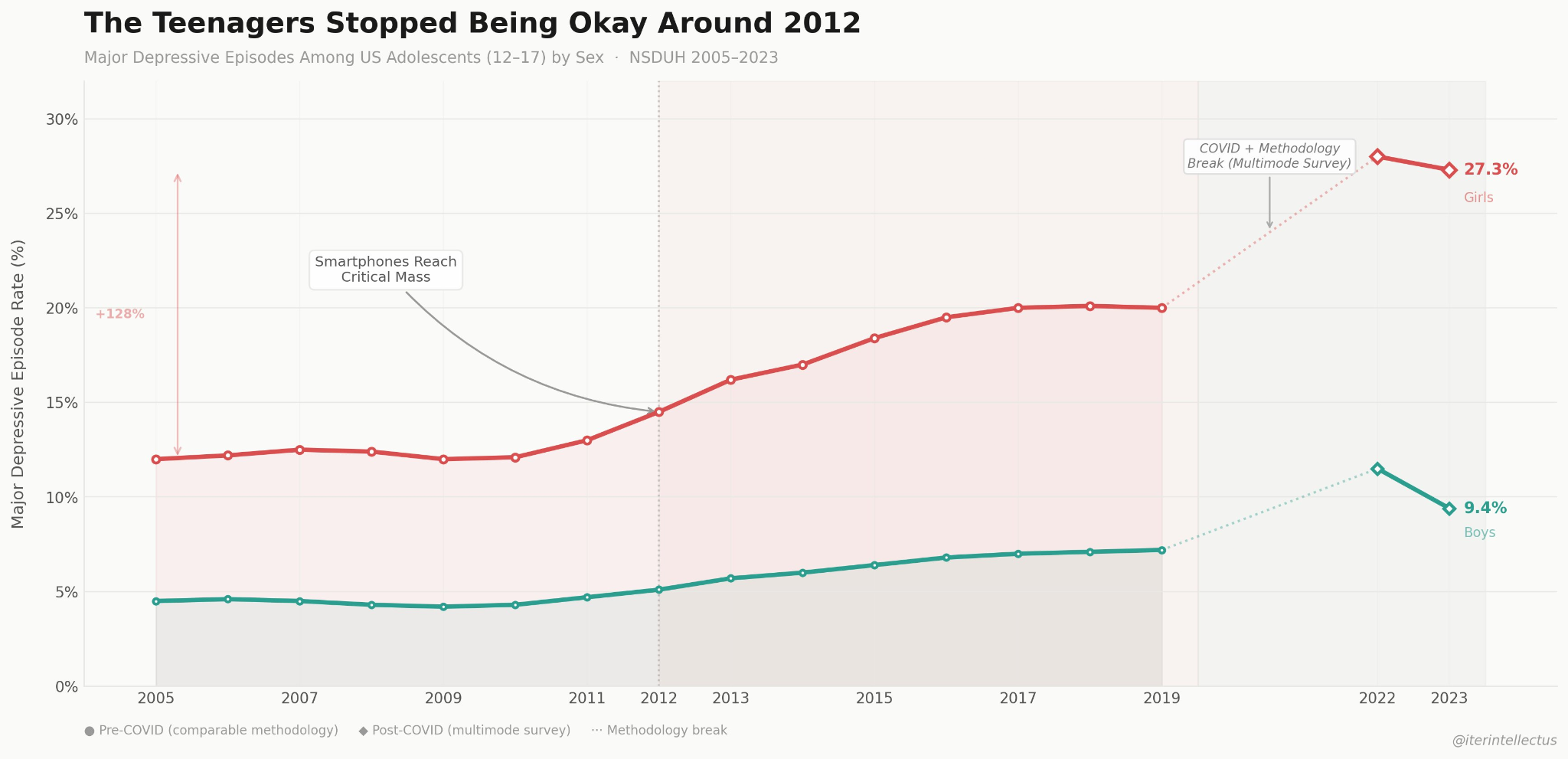
Emergency room visits for anxiety and depression in young people have reached levels that the U.S. Surgeon General has called a national emergency, prompting his June 2024 call for surgeon general’s warning labels on social media platforms. These findings are now central to a landmark trial currently underway in Los Angeles, where Meta and YouTube face claims that they deliberately designed their platforms to be addictive to minors.
The harms extend well beyond clinical mental health. Attention spans are splintering, with 70% of U.S. social media users believing the platforms have reduced their ability to focus.9 Sleep is being disrupted at epidemic scale. Physical development is affected as well. The global rise in childhood myopia has been linked to excessive screen time, and Haidt has noted that children are literally “growing hunched around their phones.”

The Deeper Threat to the State
Media-driven attention manipulation is not just a health problem at the individual level. It has destabilized societies for decades, one rooted not in technology itself but in two of humanity’s oldest psychological vulnerabilities – vanity and epistemic insecurity.
Foreign Animosity
For 99% of human history, disparities between nations existed but were not continuously visible. You couldn’t resent a lifestyle you’d never seen. Radio, television, and later the internet changed that permanently, making Western consumerism observable at planetary scale, and mankind couldn’t get enough of it. If religion is the opium of the people, video is their crack cocaine.10 What followed was humanity’s first vulnerability laid bare. Vanity. When foreign populations were exposed to material prosperity they could not easily access, the result was not admiration but status humiliation. This became incendiary fodder, as societies slip into crisis when expectations exceed the possibilities of fulfillment, often defined as the Third World rejectionist model. Leaders and movements channeled that humiliation into animated nationalist or religious narratives promising restored dignity. For example, the Islamic fundamentalist hostility toward the West that defined the late twentieth and early twenty-first centuries was far less theological than commonly understood. It was a response to cultural visibility, to the experience of watching wealth and influence they could not reach, while Baywatch and Sex and the City broadcast into their homes on loop. How could a nation of “harlots” and “hedonists” acquire such prosperity in a way so antithetical to everything we believe, they might ask? The threat didn’t come from Harvard. It came from Hollywood.11 Information and media dissemination became a geopolitical force, shaping hostility toward the U.S. through cultural exposure, ultimately culminating in the deadliest attack on American soil since Pearl Harbor, 25 years ago this September.

Domestic Decay
For decades, the destabilizing effects of media exposure were largely a foreign policy problem. Now, that same dynamic has metastasized domestically, and its internal form may prove more destabilizing. Income inequality has always existed in the U.S. and is an inevitable outcome of any governing system, including democracy. However, the modern attention economy intensifies how these disparities are perceived and socially weaponized. Social platforms compress elite lifestyles into daily feeds, accelerating status anxiety and the psychological drive toward visible possession over productive accomplishment. The mechanism is the same one that broadcast Baywatch into the homes of fundamentalists, only now short-form video on infinite scroll makes the fantasy feel intimate and deceptively attainable. To continue the analogy above, if video (movies, TV shows) is crack cocaine, then short-form video is fentanyl.
The result is an irrational attempt to verify self worth (i.e., “I have, therefore I am”), most concentrated among those who are most exposed/ addicted to the screen and most susceptible to the vanity and subconscious humiliation it produces. These are often the same emerging, aspirational, middle- to lower-income consumers now financing the image on debt. Gen Z and millennial credit card debt is rising faster than any other generation's, 59% of BNPL users (a category they lead in adoption) admit to purchasing what they cannot otherwise afford, and the bottom 60% of American households have been running negative personal savings for years, consuming more than they produce.12 When economic mobility feels slower than the status expectations set by curated digital worlds, individuals substitute symbolic wealth for contribution. Material display (e.g., luxury brands, IG-worthy vacations) becomes a proxy for dignity, and for those who cannot sustain the optics, withdrawal follows. Notably, while the attention economy’s health toll has fallen disproportionately on young women through self-harm and depression, the dignity toll has fallen disproportionately on young men, who are seceding from the workforce entirely. Among men aged 16 to 24 not in school or work, two-thirds are no longer even seeking employment, up from 40% in 1990. Meanwhile, the share of young men fully outside both school and the labor force has doubled over the same period, from 4% to 8%.13
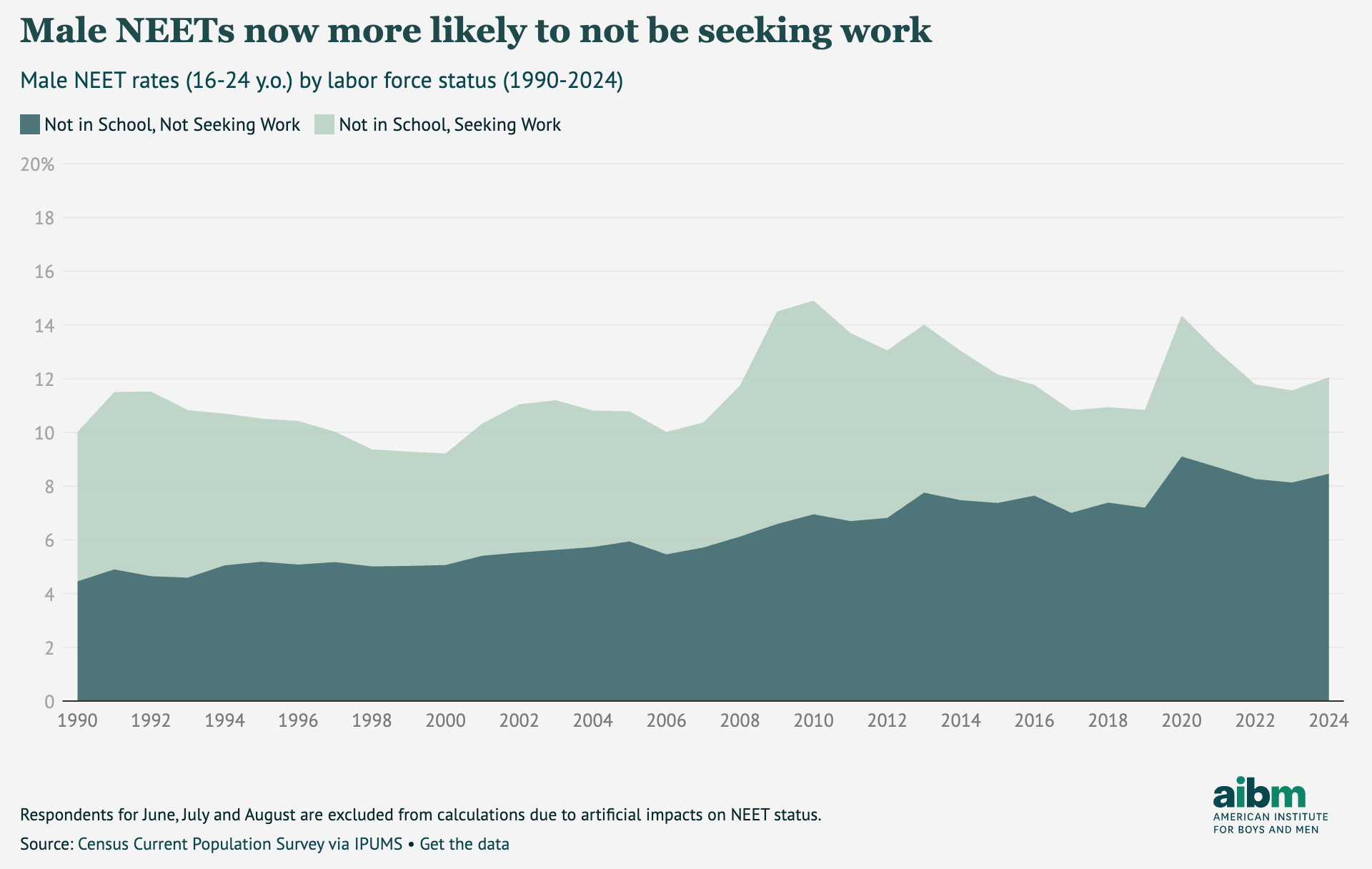
The merit- and civic-oriented value systems that hold republics together are eroding, and historically, that erosion has been existential. When a society’s aspirational class stops allocating toward productive contribution and starts allocating toward performative status, the foundation cracks. For example, Rome’s citizen-farmer class didn’t just lose their land. They lost their identity as builders, trading productive independence for patronage and spectacle while the state subsidized their pacification with bread and the Colosseum. Pre-revolutionary France’s bourgeoisie spent generations bankrupting themselves imitating aristocratic consumption they could never actually access. The pattern is well-documented and the outcomes are consistent. Once the aspirational class loses its rational economic footing and productive ambition, institutional decline follows. The difference today is speed. These dynamics took Rome and France over a century to play out. The attention economy is compressing that same arc into years, with the screen as its vector.

Democratic Erosion
But vanity is only the first vulnerability. The hypergrowth phase of content has not just amplified status comparison. It has exploited a deeper one, epistemic insecurity (i.e., the inability to reconcile what you’ve always believed with the flood of information now contradicting it), fracturing the shared information environment on which democratic societies depend. Until now, history has been a quest to acquire information. The modern challenge is filtering and interpreting overwhelming volumes of it. The minority of individuals capable of mastering information triage will navigate this era successfully. The majority who cannot are left alienated by information they cannot reconcile with their lived experience, fearful of a future they do not understand. And that alienation does not discriminate ideologically. The ultranationalist fascist on the far right and the virtue-signaling multiculturalist on the left are ironically all brothers and sisters in this sense. The result is not ignorance. It is the proliferation of competing realities, each reinforced by algorithmic feeds surgically optimized not for truth but for engagement. Political and civil infighting has intensified not because Americans fundamentally disagree more than they once did, but because ideological mismatches that were once local and quiet are now continuously visible, amplified, monetized, and, worst of all, politically weaponized. Every disagreement becomes a tribal marker. Every grievance finds an audience. Every fracture is widened by a system designed to keep people watching.
“The Internet is to the techno-capable disaffected what the United Nations is to marginal states: It offers the illusion of empowerment and community.”
-Ralph Peters, Fighting for the Future
In this context, the attention economy does not merely degrade individual health. It undermines the social cohesion on which functional democracies depend. History was once shaped by the pursuit of information. The modern era will be shaped by whether societies can manage it and protect their attention from both private and public sector stakeholders who desire to exploit it. And nowhere is that question more urgent than in the formation of the generation that will inherit these institutions.

Protecting What Matters Most: Our Future Generations
Consider what it means that a generation of children is forming its worldview not through conversations with parents, teachers, peers, or even the slow process of self-discovery through reading and reflection, but through algorithmically curated content designed primarily to maximize time-on-platform. The implications for our emerging generations’ civic literacy, institutional trust, and independent thought are still compounding, but if the clinical trendlines in adolescent depression and self-harm since 2012 are any prologue, the prognosis is bleak.
China, our biggest adversary, appears to have recognized this earlier than the West. Douyin, the Chinese version of TikTok, restricts minors to 40 minutes per day of exclusively educational content, with no access between 10pm-6am. Australia became the first country to ban social media for children under 16 in December 2025, with penalties of up to $49.5 million for non-compliant platforms. The European Parliament has advocated a minimum age of 16 for social media access. In the United States, 22 states enacted school cellphone bans in 2025 alone, with New York allocating $13.5 million for phone storage devices in schools.
These are meaningful signals. But they are also reactive, piecemeal, and a decade late. The regulatory impulse is to restrict access after the damage has been done, rather than to build protective infrastructure from the start. Compare this to how we think about food safety, environmental regulation, or pharmaceutical oversight. In each of those domains, we recognize that the burden of proving safety belongs to the producer, not the consumer. In the attention economy, we have inverted that principle entirely. The platforms capture the value, the users bear the risk, and the most vulnerable users, our youth, have no meaningful protection at all.
The Response Landscape: Hardware, Software, and the Space Between
Having laid out why this matters, here's where the market stands. Growing awareness of attention manipulation as an existential threat is creating incentive for innovative solutions. A new ecosystem of products is emerging, spanning hardware-based solutions, software-driven tools, and most recently, AI-native attention agents. The market segments into two distinct populations with different needs: 1) children and adolescents, where the problem is fundamentally about protection and developmental guardrails, and 2) adults and knowledge workers, where the challenge is self-governance and reclaiming intentional time.
Children and Adolescents
For families with young children and teenagers, the solutions landscape includes both analog instruments and increasingly sophisticated software. And yet, no tool substitutes for the most consequential variable, which is how parents frame the device itself. A phone handed to a child as a pacifier, something to buy quiet in a grocery line or a car ride, teaches a fundamentally different relationship with technology than one thoughtfully introduced as a selective instrument for education and imagination. The distinction matters enormously, and the data suggests it tracks with income. A December 2025 study in Pediatrics examining over 10,000 U.S. youth found that smartphone ownership by age 12 was associated with higher risks of depression, obesity, and insufficient sleep, and that children in lower-income households had the highest rates of ownership and earliest acquisition. Common Sense Media’s 2025 census reported that children from lower-income families log nearly twice the daily screen time of their higher-income peers. This is not a mystery of preferences. Parents stretched thin by shift work, housing instability, and inadequate childcare reach for the tool that works right now. The phone becomes a co-parent by default, making the case for intervention impossible to ignore.
On the hardware side, the “dumb phone” movement has accelerated meaningfully. Google searches for “dumb phone” have risen sharply since 2023, peaking in June 2024 after the publication of Haidt’s book.14 Between 2021 and 2024, “dumb phone” sales grew 148%, led by 18-to-24-year-olds.15 Companies like Tin Can, Bark Phone, and Gabb are building real businesses around the premise that the best way to protect a child’s attention is to never hand them a supercomputer.
The software side is more complex. Incumbent family safety platforms like Life360, Aura, Bark, and Qustodio offer content filtering, location tracking, and screen time limits. But these products have historically been fragmented, clunky, and brittle. Parents describe screentime loss of control as a top-three household stressor.16 Onboarding friction for these incumbent applications are high, kids rapidly find workarounds, and the products struggle to keep pace with the 80%+17 of children’s devices that run Apple’s iOS, where Screen Time APIs are powerful but limited, and MDM-based approaches are onerous for families. Complicating the landscape further, parent personas vary widely, from strict blockers drawn to tools like Bark and Aura, to those who consider Apple’s native Screen Time controls sufficient. The “mushy middle” between these poles represents a large, heterogeneous segment whose diverse needs demand different tool combinations rather than a single monolithic solution.
Clearspace represents the next generation of this category. Rather than layering controls on top of individual apps or relying on brittle OS-level permissions, Clearspace routes all device traffic through a VPN, placing an AI agent at the network layer itself. This agent observes traffic in real time, understands context, and enforces natural-language rules set by parents. Instead of configuring complex rules through clunky dropdown interfaces, a parent can simply tell the AI what they want through a semantic chat layer (”no YouTube on weekdays”, “homework mode after 4pm”) and have the system implement and enforce those rules across devices. The result is something closer to a cognitive firewall than a parental control app, and one that was technically impossible even 18 to 24 months ago.
Adults and Knowledge Workers
The solution set here, similar to the child and adolescent market, is split between software and hardware. On the software side, Clearspace plays in this segment as well. Its attention agent architecture is not limited to parental use cases and applies equally to adults seeking to govern their own device behavior through natural-language rules. Opal is another prominent entrant, reporting that users save an average of one hour and 23 minutes per day, with focus sessions, smart scheduling, and social accountability features.
However, software solutions for this end market may be fundamentally limited. The user is simultaneously the rule maker and the person subject to the rules (i.e., the system only works as long as willpower does). For the knowledge worker use case, the more compelling opportunity may lie in physical barriers and interventions delivered through hardware. Nothing is more effective than literally embedding physical friction into the environment to break compulsive loops.
BRICK does a simple but elegant job of this. Rather than relying on a digital pause screen, BRICK uses a hardware token, a physical object placed somewhere deliberate like the refrigerator across the room, that must be tapped to unlock a distracting app. If accessing Instagram requires you to physically stand up, walk to another room, and tap your phone to a device, the compulsive loop is broken not by willpower but by inconvenience.
Ohm Health approaches the problem from a different angle, offering an elevated way to dissociate from screens and stress by building a daily ritual around breathwork via a device that feels like it came straight out of Cupertino. Where BRICK intervenes at the moment of compulsion, Ohm Health builds a proactive ritual and a physical offramp from the digital environment that doubles as a stress management tool.
Light Phone takes the hardware intervention to its extreme. It is a stripped-down, beautifully designed phone that does calls, texts, directions, and little else. Much like the dumb phone movement gaining traction among families with children, Light Phone reflects a growing willingness among adults to opt out of the smartphone entirely.
And lastly, for individuals for whom self-directed software and hardware approaches prove insufficient, companies like Birches Health provide evidence-based treatment for addiction and other attention-related behavioral challenges that have come to define our age, including social media, sports betting, video games, and pornography.
The Investment Thesis for Attention
From an upstream care perspective, the attention crisis represents a massive, under-addressed category with strong structural tailwinds. It sits at the intersection of mental health, productivity, child development, and civic resilience, touching virtually every dimension of human potential. Digital natives are now the majority of U.S. parents and smartphone penetration is ubiquitous.18
The market is shifting in the right direction, but far too slowly relative to the scale of the problem. We have spent a generation building the most sophisticated attention-harvesting infrastructure in human history and have invested almost nothing, by comparison, in attention protection. The asymmetry is breathtaking.
For healthcare investors focused on consumer health, the question is not only whether attention protection will become a large category, but whether it can scale against an opposing force that may be structurally insurmountable. The largest and most well-capitalized companies in the world are economically aligned on the other side of this trade, and a fragmented market of interventions will struggle to proliferate against that gravity without meaningful regulatory or cultural tailwinds.
Even so, the urgency remains. The data is in, the harm is real, and, thankfully, the tools are emerging. The only thing missing is the collective will to treat this like what it is, a public health emergency and potentially an existential threat to the cognitive foundations that sustain individual potential and democratic self-governance alike.
If you are building or investing within our whole person health thesis, we’d love to chat! Please reach out to jordan@nextventures.com or head over to our website.
J.P. Morgan, EU Spotlight: Peak Screen? Exploring the Future of Smartphone Usage & the Attention Economy, Europe Equity Research, 21 November 2025.
J.P. Morgan, EU Spotlight: Peak Screen? Exploring the Future of Smartphone Usage & the Attention Economy, Europe Equity Research, 21 November 2025.
J.P. Morgan, EU Spotlight: Peak Screen? Exploring the Future of Smartphone Usage & the Attention Economy, Europe Equity Research, 21 November 2025.
J.P. Morgan, EU Spotlight: Peak Screen? Exploring the Future of Smartphone Usage & the Attention Economy, Europe Equity Research, 21 November 2025.
J.P. Morgan, EU Spotlight: Peak Screen? Exploring the Future of Smartphone Usage & the Attention Economy, Europe Equity Research, 21 November 2025.
J.P. Morgan, EU Spotlight: Peak Screen? Exploring the Future of Smartphone Usage & the Attention Economy, Europe Equity Research, 21 November 2025.
Sparks, Sarah D. "How Old Kids Are When They Get Their First Phone, According to a New Survey." Education Week, July 31, 2025. https://www.edweek.org/leadership/how-old-kids-are-when-they-get-their-first-phone-according-to-a-new-survey/2025/07
Mercado, Holland, Leemis, et al., "Trends in Emergency Department Visits for Nonfatal Self-inflicted Injuries Among Youth Aged 10 to 24 Years in the United States, 2001–2015," JAMA, November 21, 2017, 318(19): 1931–1933
J.P. Morgan, EU Spotlight: Peak Screen? Exploring the Future of Smartphone Usage & the Attention Economy, Europe Equity Research, 21 November 2025.
Ralph Peters, Fighting for the Future: Will America Triumph? (Mechanicsburg, PA: Stackpole Books, 1999), 00.
Ralph Peters, Fighting for the Future: Will America Triumph? (Mechanicsburg, PA: Stackpole Books, 1999).
Credit Karma, “Millennials and Gen Z Rack Up Credit Card Balances Amid Sky-High Interest Rates,” 2024, https://www.creditkarma.com/about/commentary/millennials-and-gen-z-rack-up-credit-card-balances-amid-sky-high-interest-rates; LendingTree, “Buy Now, Pay Later Survey,” 2024, https://www.lendingtree.com/personal/buy-now-pay-later-survey/; Bureau of Labor Statistics, “The Polarization of Personal Saving,” Working Paper EC240050, 2024, https://www.bls.gov/osmr/research-papers/2024/pdf/ec240050.pdf.
Ravan Hawrami and Richard V. Reeves, "A Generation of Lost Men? The Reality of NEET Data," American Institute for Boys and Men, May 21, 2025.
J.P. Morgan, EU Spotlight: Peak Screen? Exploring the Future of Smartphone Usage & the Attention Economy, Europe Equity Research, 21 November 2025.
J.P. Morgan, EU Spotlight: Peak Screen? Exploring the Future of Smartphone Usage & the Attention Economy, Europe Equity Research, 21 November 2025.
C.S. Mott Children’s Hospital, University of Michigan Health, “Top Health Concerns for 2025,” National Poll on Children’s Health, August 2025. Survey of 2,021 U.S. parents of children ages 1–18, conducted February 2025 by Ipsos. https://mottpoll.org/reports/top-health-concerns-2025
Piper Sandler. “Taking Stock With Teens® Survey, Fall 2025.” 50th Semi-Annual Survey, in partnership with DECA. October 9, 2025. https://www.pipersandler.com/teens
Damianos, Giana. "2024 Generations Demographics: Size Your Brand's Opportunities with Updated Demographic Insights." Collage Group, January 2024. https://www.collagegroup.com/2024-generations-demographics
 | A guest post by
|