
Doubling Down on Trial Library
Making clinical trials a standard part of cancer care.

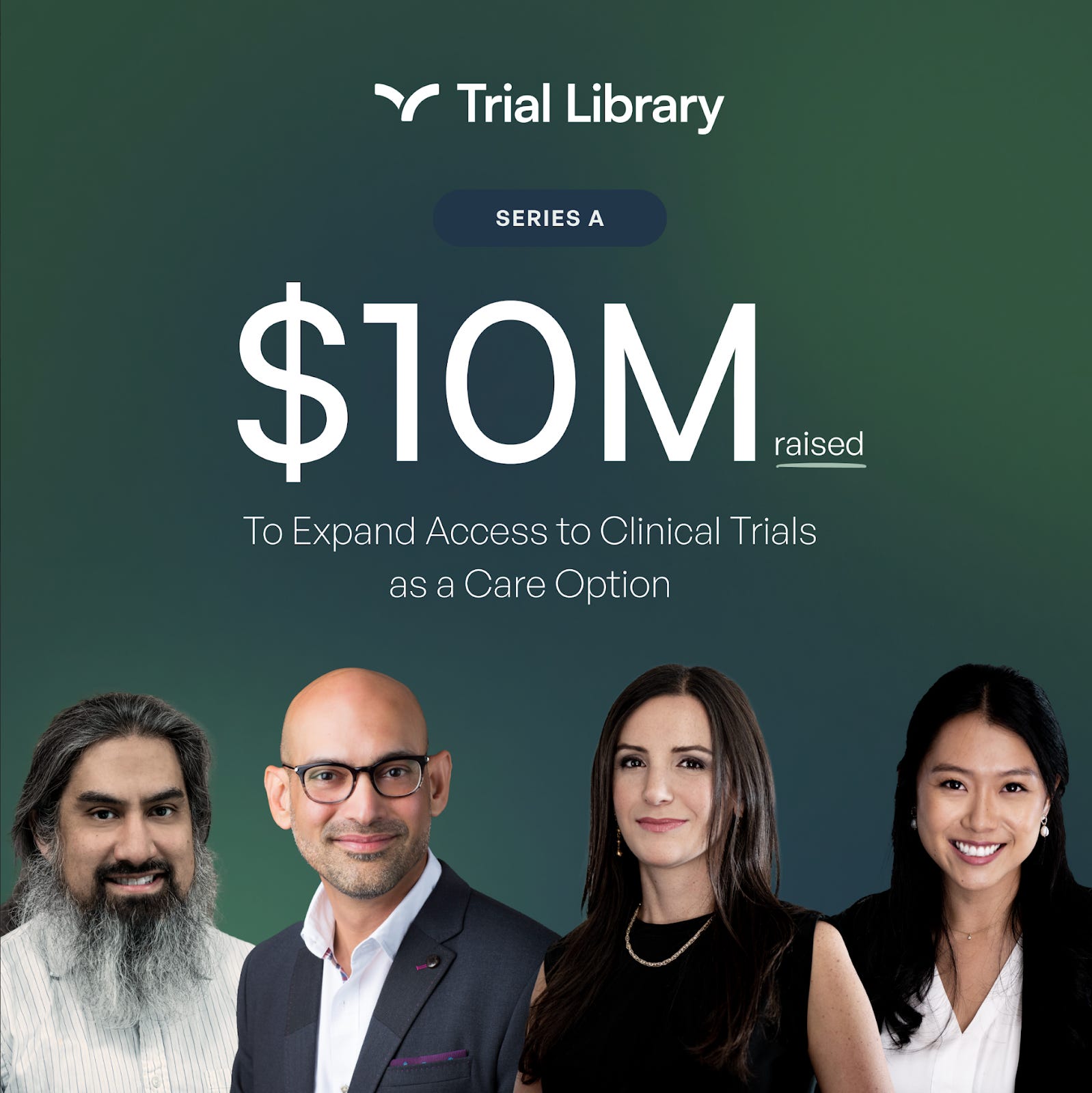
At Next Ventures, we’ve always believed that clinical trials are not simply a research mechanism; they are an essential option for care. Anyone who has lived through cancer or stood next to someone who has knows that access to cutting-edge therapies is often the difference between hope and resignation. That belief shaped the foundation of our firm and continues to guide our focus on advancing innovations that expand access and elevate the quality of care. Lance Armstrong, our founder, survived advanced cancer because he had access to top clinicians, aggressive treatment options, and therapies not yet widely available. His story is a reminder of something uncomfortable but true: the right options at the right moment save lives. But those options are not distributed evenly.
For most cancer patients in the United States, clinical trials are not presented as a viable, accessible pathway. They remain structurally out of reach. It’s an accident of geography, information asymmetry, or the simple fact that 85% of cancer care happens in community settings that lack the tools, infrastructure, or time to meaningfully engage in research.1 Providers overwhelmingly want to do right by their patients, but identifying trials, determining eligibility, navigating logistics, and coordinating records across sites is work layered on top of an already overloaded system. The result is that fewer than 5% of eligible patients ever participate in a trial, even though ~77% of enrollment ultimately hinges on a provider’s recommendation.2 The gap between what is medically possible and what patients actually access is massive.
Trial Library is closing that gap with a model that has proven uniquely effective. From the moment we invested at inception, we saw something rare – a physician-scientist founder whose professional life has been spent studying and fixing this exact problem, and a product built from evidence rather than convenience. Dr. Hala Borno’s research at UCSF fundamentally reshaped how providers search for trials, how patients overcome the “last mile” between referral and enrollment, and how navigation grounded in social determinants of health can turn eligibility into actual participation. Trial Library takes that evidence base and turns it into an end-to-end, AI-native platform that activates the treating oncologist, identifies eligible patients at the point of care, and supports them through the logistical and emotional challenges that prevent most from ever reaching a trial site.
What has impressed us further is how deeply this model resonates with the people who deliver and fund cancer care. Trial Library has earned the trust of leading global biopharmaceutical companies, major cancer foundations, and large oncology networks not by brute-forcing its way in, but by offering something the system didn’t have: a unified infrastructure that gives community providers the ability to participate in research and gives patients a real chance at therapies they would never otherwise be offered. And with every contract, every referral, and every deeper expansion into a customer’s ecosystem, the company moves closer to making clinical trials a mainstream, equitable part of cancer care – not a privilege reserved for the few.
We are doubling down in the Series A because this mission isn’t theoretical for us; it’s real and deeply personal. If science is to continue moving at the pace it needs to, patients must have access to it. Trial Library is making that possible at national scale, and we are proud to support that future.
We are joined by new investors Semper Virens, Sanofi Ventures, and Civilization Ventures, alongside continued support from Lux Capital, Overwater Ventures, and other value-added partners who share our commitment to expanding access to clinical trials as a standard care option.
Every month we write a piece encompassing themes within our whole-person health investment thesis. If you would like to receive it directly in your inbox, subscribe now.
https://www.cancer.gov/research/areas/disparities/chanita-hughes-halbert-clinical-trials-community-access#:~:text=Approximately%2085%25%20of%20cancer%20patients,most%20clinical%20trials%20take%20place.
https://ascopubs.org/doi/10.1200/EDBK_156686; https://www.nih.gov/health-information/nih-clinical-research-trials-you/need-awareness-clinical-research